

.svg)
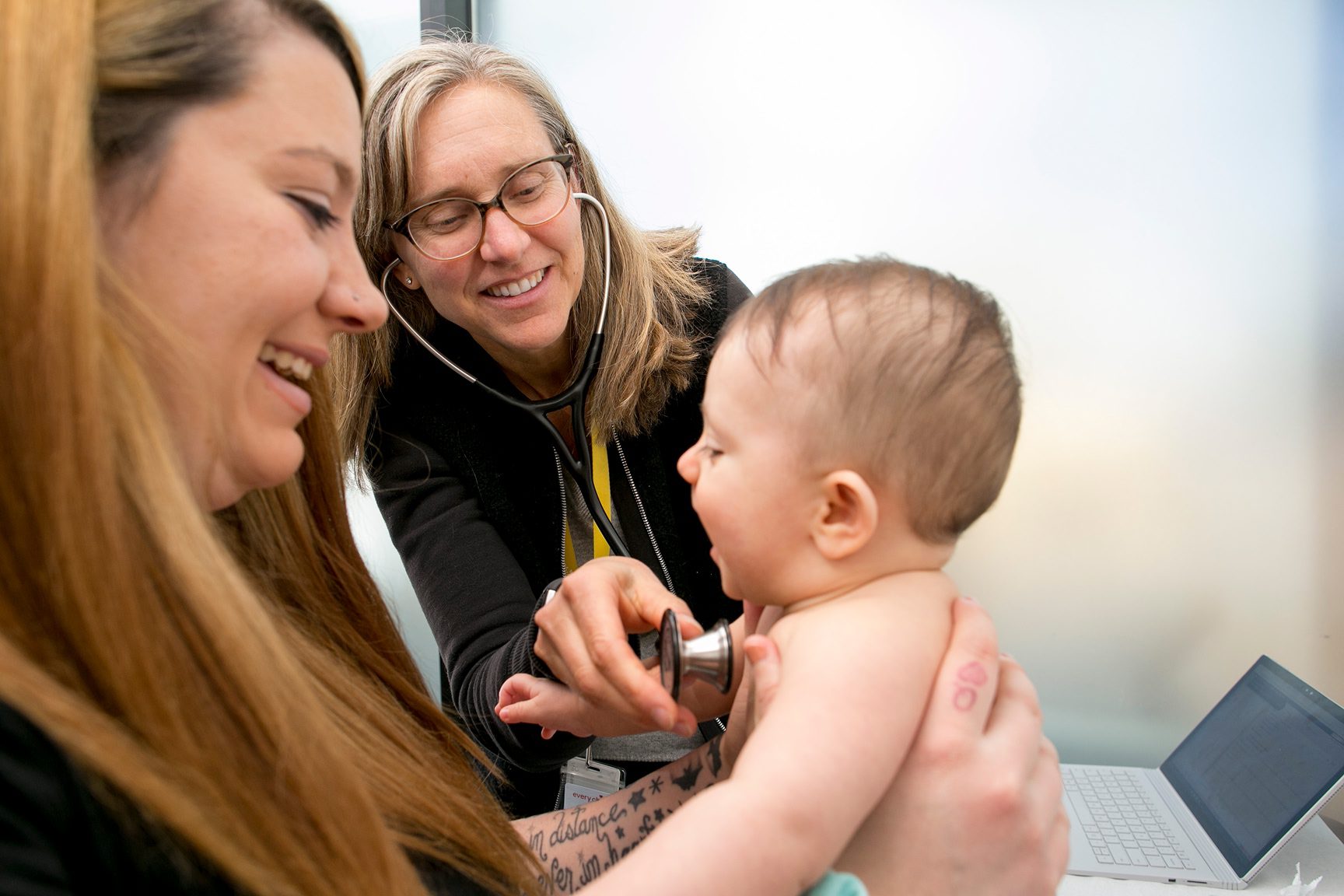
For 27 years, Dr. Jennifer Burns has dedicated her career to Every Child Pediatrics to serve underserved children, regardless of their ability to pay.
“There are so many people who want to donate their time, their money, their expertise, to a good cause.
I think we are that cause.”
Dr. Burns’ journey to Every Child Pediatrics began in 1997, as she was finishing her residency at Children’s Hospital Colorado. As a young new doctor, she was searching for meaningful work that aligned with her both training and her values.
That opportunity arrived unexpectedly. At a job fair, Dr. Burns reconnected with a former colleague who had recently joined a small but growing organization called Rocky Mountain Youth Clinics – now known as Every Child Pediatrics. Upon hearing the mission, she knew she had found what she wanted to do after residency.
There was just one problem: there wasn’t a full-time position available. Eager to begin her career, Dr. Burns decided to continue her work at Children’s Hospital, while staying in close contact with RMYC’s founder, Dr. Larry Wolk.
A year later, an opportunity opened up. And in 1998, she officially joined the organization that would become Every Child Pediatrics.
“It’s just a really, really powerful mission.”
Back then, the organization looked very different. With only a handful of providers and a few clinic locations, Dr. Burns spent her days traveling across the Denver metro area, seeing patients wherever the need was greatest.
“That was kind of the fun of it – seeing new people at different offices every single day.”
Over time, that model evolved. ECP expanded to open new clinics across Colorado, including the Lakewood office where Dr. Burns practices today. Now, she’s able to provide consistent, continuous care for her patients, building lasting relationships with the families she serves.
A MODEL OF INTEGRATED CARE
For Dr. Burns, patient-centered care extends beyond her role as a physician – it’s an integrated approach that treats the whole child. At the Lakewood clinic, there is a shared space for all attending staff: physicians, mental health specialists, dietitians, nurses, and medical assistants. This unique setup allows for integrated care to happen in real time.
If Dr. Burns is seeing a child for a sore throat, she may notice other concerns, such as if the child is underweight or exhibiting behavioral health symptoms. With all specialties on-site, she can bring in a dietitian or mental health provider right away, or help coordinate follow-up care.
“These additions have been monumental,” she explains. “Our patients have a lot of extra needs, and it’s hard to connect them to resources. When you can do that face-to-face, it really opens the door to better care.”
Equally important is the relationship she builds with each family. As a primary care pediatrician, Dr. Burns sees patients for well visits, sick visits, follow-ups, and ongoing treatment plans, often over many years. Since most children are accompanied by a parent or guardian, trust must be built across all three: physician, child, and caregiver. For Dr. Burns, it’s that collaborative relationship that becomes the foundation for long-term care.
A DIFFERENT KIND OF CARE
But unfortunately, not every child has a family to help guide their care.
Urban Peak is a homeless youth shelter on South Broadway, serving minors and new adults roughly between the ages of 15 and 24. Dr. Burns practices there every Tuesday, and has since she started at ECP.
Unlike at a family shelter, most of her patients are navigating homelessness without the support of a parent or guardian. Healthcare, understandably, is not always their top priority. That’s where Dr. Burns comes in – treating her patients’ immediate medical needs while still recognizing their day-to-day realities.
“I mean, their top priority is they have no stable housing. So I usually ask the kids: What are your goals for staying here? What do you want to get out of this shelter?”
Inside the shelter, the clinic space is small and resources are limited. Unlike the Lakewood clinic, there isn’t a full care team – just the provider and the patient. Dr. Burns’ main role is to provide minor acute care, such as headaches, sore throats, or routine vaccinations. But in nearly three decades of working with Urban Peak, she has seen how deeply intertwined mental and physical health are, with most of her patients also navigating substance use or trauma disorders.
While the shelter does provide mental health diagnoses and treatment plans, they are not integrated with ECP providers, making coordination difficult.
“It’s hard to know what support they’re receiving unless they tell you,” she explains. “And often they don’t fully understand it themselves, or they can’t follow through with any sort of care plan.”
So for Dr. Burns, care at Urban Peak is less about long-term treatment plans and more about showing up consistently and building trust in a setting where stability is rare. Over time, she has seen how consistent access to health care can help young people move toward employment, housing, and independence.
THE COMPLEXITY OF CARE
Across all of her care settings, Dr. Burns has found that no two patients are the same, and neither are the challenges they face.
“Every situation is unique,” Dr. Burns says. “We could talk about 50 patients and have 50 different barriers to care.”
For some, it’s a transportation issue. For others, it may be mental health challenges, parental substance use, youth substance use, or an insurance complication. And sometimes, families just aren’t ready to accept help. But Dr. Burns doesn’t view those moments with defeat or discouragement. Every family’s situation is different, and she remains present for patients whenever they are ready.
“A lot of people have been burned by the healthcare system before,” she says. “That becomes its own barrier.”
Still, the patients who stand out to Dr. Burns are those who become active participants in their own care. These relationships shift the dynamic from basic medical treatment to a more collaborative partnership between doctor, parent, and child.
“The people that come to mind are the people who become part of the team with us,” she explains. “I respect their involvement in their child’s care, they respect my involvement, and they’re open to having different team members play a role. And that feels really good.”
A MISSION THAT ENDURES
After nearly three decades at ECP, Dr. Burns’ commitment to the mission has never wavered. As she puts it, “Hey, I wouldn’t have stayed here for 27 years if I didn’t believe in the mission of what we’re doing!”
For Dr. Burns, that mission has never been about recognition. She’s not interested in praise or attention for her charitable work. “I’m not a salesperson,” she says. “That’s not why I’m here.”
But, what she does wish is that more people understood what Every Child Pediatrics really is – and how they can be part of it.
“I think there are a lot of people who want to give back,” she says. “They just don’t know how.”
Support doesn’t only mean financial contributions. It can be time, advocacy, volunteer work, or simply spreading awareness of the barriers these children face when accessing healthcare.
“It’s not just money that we need,” she explains. “We need voices to stand up for kids who don’t have the resources… with your vote, your time, your expertise, whatever it is.
Ultimately, she hopes more people see Every Child Pediatrics not as a distant “good cause,” but as something they can tangibly and meaningfully engage with.
“This is a powerful mission,” she says. “There are people out there who would feel energized by this work if they knew about it.”
And after 27 years, Dr. Burns is as energized as ever – showing up every day, for every child.
