.svg)
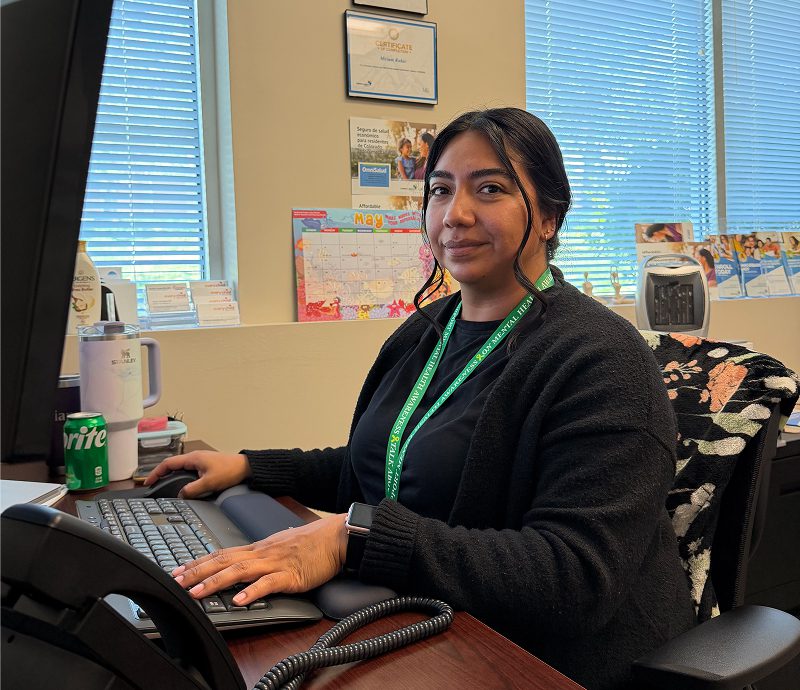
After more than six years of serving families at Every Child Pediatrics, Miriam Rubio was ready to step into an exciting new role: Certified Application Counselor.
Last year, Miriam transitioned from working at the front desk in ECP’s school-based clinics into a newly created position dedicated to helping families navigate Colorado’s Medicaid program, Health First Colorado. Today, Miriam works directly with parents and families to help them access and maintain insurance coverage.
The role of Certified Application Counselor was created in response to the return of Medicaid redetermination, which has affected thousands of Colorado families since pandemic-era protections ended in 2023. Redetermination is the process of reviewing income, household size, disability status, and other factors to determine Medicaid eligibility.
Since 2023, nearly 48% of Medicaid redetermination reviews in the state have resulted in disenrollment, compared to a national average of 31%. For many families, disenrollment does not necessarily reflect a loss of need, but rather the challenges of paperwork, documentation requests, and communication with county offices.
That’s where Miriam steps in.
When enrolling in Medicaid, families are asked to provide proof of income, social security documentation, birth certificates, or other verification forms. Many families are unsure of what specific documentation is required, how to submit their paperwork correctly, or how to respond to requests from the county. And simply missing a deadline can result in full loss of coverage, even if the child should still technically qualify.
Miriam recalls a family she worked with whose young son was receiving physical therapy for a chronic condition. After the child’s mother missed the Medicaid reenrollment deadline, he lost insurance coverage for 30 days, interrupting his access to important therapy appointments.
Miriam worked closely with the mother to complete the necessary paperwork, gather the required documentation, and restore coverage as quickly as possible. Through Miriam’s support and guidance, the child was successfully reenrolled in Medicaid and able to continue receiving the services he needed.
“Sometimes families lose coverage simply because they didn’t send one document or didn’t understand a letter they received,” Miriam explains.
Miriam understands how difficult and confusing communication with county offices can be, so she stays closely involved in each family’s case to help guide them through the process. If families do not hear back from the county within 45 days, Miriam begins checking their application status weekly. She then helps families contact county offices directly to confirm whether documents were received or if additional information is needed.
While navigating the procedural side of insurance enrollment can be overwhelming for any family, Miriam says immigrant households often face an additional layer of fear and uncertainty.
Approximately 80% of the families Miriam works with are undocumented or part of mixed-status households. Many families fear applying for government assistance because of immigration concerns or fear of deportation.
Miriam recalls another family she worked with recently at ECP’s Thornton clinic. They were seeking help for their 4-year-old child, who did not have insurance coverage. The child’s mother had delayed applying for Medicaid for nearly a year because of concerns surrounding her pending immigration status. Unsure of what to do and overwhelmed by the process, the mother waited nearly a year before finally connecting with Miriam.
Miriam was able to refer the mother to an immigration lawyer and help the family begin the enrollment process. Their application is now pending, and Miriam expects it could be approved within 30 to 45 days.
In many situations such as this, Miriam encourages families to speak with an immigration attorney before making decisions about enrollment. She also educates families about available coverage options, explaining that as long as household income requirements are met, undocumented children may still be able to receive Health First Colorado or CHP+ in the case of an emergency.
Many of these policies and eligibility rules are not widely known to families, and they are also constantly shifting. As she continues helping families navigate today’s enrollment challenges, Miriam is also preparing for the impact of future policy changes.
While hopeful about the work being done at ECP, Miriam is concerned about what lies ahead for many families.
“Negative changes are coming in 2027 – especially for families without a social security number.”
In the upcoming years, certain immigrant groups are expected to lose access to coverage, including refugees and other humanitarian groups. In addition, some redetermination reviews will move from annual renewals to every six months, increasing the likelihood that families could lose coverage because of procedural issues. Starting in 2027, retroactive Medicaid coverage for some groups will also be reduced from 90 days to as little as 30 to 60 days.
At the same time, Health First Colorado is projecting significant financial pressures in the coming years, with estimated funding constraints ranging from $900 million to $1.5 billion.
Miriam says fear surrounding these procedural policies and immigration enforcement is already affecting many of the families she serves. She hopes community members can help by spreading awareness, supporting Medicaid reform efforts, and engaging with local leaders and board members about the importance of maintaining healthcare access for vulnerable families.
But despite the uncertainty ahead, Miriam says one thing remains constant at ECP – our mission to serve every child, no matter what.
“The best thing about Every Child Pediatrics is that even if the families don’t qualify, they still come back because they still get treatment,” she said.
While we want every family to have the security of insurance coverage, some experience long waits for approval, and others simply don’t qualify at all. In these moments, we continue to provide services regardless of the family’s ability to pay. Because at Every Child Pediatrics, care continues even when coverage does not.